AMETHYST


Amethyst: a Royal Purple
Purple has long been considered a royal color so it is not surprising that amethyst has been so much in demand during history. Fine amethysts are featured in the British Crown Jewels and were also a favorite of Catherine the Great and Egyptian royalty. Amethyst, transparent purple quartz, is the most important quartz variety used in jewelry.

Leonardo Da Vinci wrote that amethyst was able to dissipate evil thoughts and quicken the intelligence.


In Tibet, amethyst is considered to be sacred to Buddha and rosaries are often fashioned from it.

The Greek work "amethystos" basically can be translated as "not drunken." Amethyst was considered to be a strong antidote against drunkenness, which is why wine goblets were often carved from it! The gemstone still symbolizes sobriety
The legend of the origin of amethyst comes from Greek myths. Dionysius, the god of intoxication, was angered one day by an insult from a mere mortal and swore revenge on the next mortal that crossed his path, creating fierce tigers to carry out his wish.

Amethyst ranges in color from pale lilac to deep purple. The pale colors are sometimes called "Rose de France" and can be seen set in Victorian jewelry. The deep colors are the most valuable, particularly a rich purple with rose flashes

Amethyst is mined in Brazil, Uruguay, Bolivia and Argentina, as well as in Zambia, Namibia and other African countries.

Generally, amethyst from South America tends to be available in larger sizes than African amethyst but amethyst from Africa has the reputation for having better, more saturated, color in small sizes. Very dark amethyst, mostly in small sizes, is also mined in Australia.

Amethyst is available in a wide range of calibrated sizes and shapes, including many fancy shapes. Large fine stones may be sold in free sizes but generally amethyst is cut in standardized dimensions

ALEXANDRITE


Alexandrite :


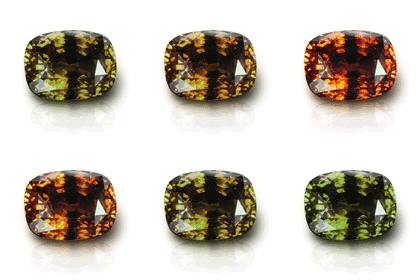
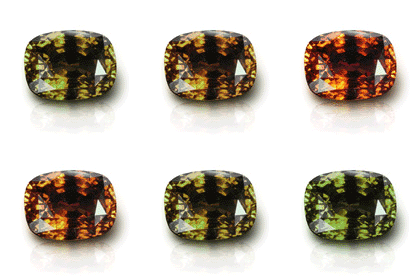
This rare gemstone is named after the Russian tsar Alexander II (1818-1881), the very first crystals having been discovered in April 1834 in the emerald mines near the Tokovaya River in the Urals. The discovery was made on the day the future tsar came of age. Although alexandrite is a relatively young gemstone, it certainly has a noble history. Since it shows both red and green, the principal colours of old Imperial Russia, it inevitably became the national stone of tsarist Russia.Beautiful alexandrite in top quality, however, is very rare indeed and hardly ever used in modern jewellery. In antique Russian jewellery you may come across it with a little luck, since Russian master jewellers loved this stone. Tiffany’s master gemmologist George Frederick Kunz (1856-1932) was also fascinated by alexandrite, and the jeweller’s firm produced some beautiful series of rings and platinum ensembles at the end of the 19th and beginning of the 20th century. Smaller alexandrites were occasionally also used in Victorian jewellery from England.

The magic of changing colours


The most sensational feature about this stone, however, is its surprising ability to change its colour. Green or bluish-green in daylight, alexandrite turns a soft shade of red, purplish-red or raspberry red in incandescent light. This unique optical characteristic makes it one of the most valuable gemstones of all, especially in fine qualities.Alexandrite is very scarce: this is due to its chemical composition. It is basically a chrysoberyl, a mineral consisting of colourless or yellow transparent chrysoberyl, chrysoberyl cat’s eye and colour-changing alexandrite (also in cat’s eye varieties). It differs from other chrysoberyls in that it not only contains iron and titanium, but also chromium as a major impurity. And it is this very element which accounts for the spectacular colour change. Rarely, vanadium may also play a part. According to CIBJO nomenclature, only chrysoberyls displaying a distinct change of colour may be termed alexandrite.Like many other gemstones, alexandrite emerged millions of years ago in a metamorphic environment. But unlike many others, its formation required specific geological conditions. The chemical elements beryllium (a major constituent in chrysoberyl) and chromium (the colouring agent in alexandrite) have contrasting chemical characteristics and do not as a rule occur together, usually being found in contrasting rock types. Not only has Nature brought these contrasting rock types into contact with each other, but a lack of the chemical element silica (the second most common element in the Earth's crust) is also required to prevent the growth of emerald. This geological scenario has occurred only rarely in the Earth's history and, as a result, alexandrite crystals are very scarce indeed.

A gemstone for experts and gemstone lovers

With its good hardness of 81/2, alexandrite is an uncomplicated stone to wear. The more distinct the change of colour, the more valuable the stone. A fine alexandrite should show a vivid bluish-green in daylight and a purplish-red in artificial light, without any trace of undesirable brown or grey. If the origin of the stone is known beyond dispute to be Russia, we are talking about a real rarity of enormous value. Finely faceted alexandrites above one carat are thus among the most expensive gemstones in the world, rarer than fine ruby, sapphire or emerald. Alexandrite is a stone for experts, enthusiasts and connoisseurs, a true understatement stone. Its uniqueness and high value are not evident at first sight. The mysterious colour change will only occur on exposure to different light sources. But if you really get involved in alexandrite, you will be utterly fascinated by this gem. Maybe you will also feel some of the mysterious magic and lore ascribed to it. It is considered a stone of very good omen. In critical situations it is supposed to strengthen the wearer’s intuition, and thus help him or her find new ways forward in situations where logic will not provide an answer. Alexandrite is also reputed to aid creativity and inspire imagination.

FIRE OPAL


Fire Opal :


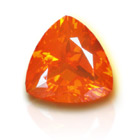
Fire opals are unique in the lush world of the opals. They were already admired as symbols of the most fervent love in ancient times, in India and in the ancient Persian kingdom, and among the peoples of Central America and the Amerindians. It was believed that a gem that bubbled over with vivacity to such an extent as the fire opal could only have been created in the waters of paradise. The Mayas and Aztecs loved this gemstone and liked to use it in mosaics and for ritualistic purposes. They called it quetzalitzlipyollitli, the 'stone of the bird of paradise'. Yet one day, the gemstone knowledge of Mexico's natives, which had been handed down from generation to generation, somehow sank into oblivion for a long time .... until, in or around the year 1835, the fiery treasures hidden in the Mexican highlands were remembered, and work was gradually begun on the systematic mining of the places where they had been found. Today, the fire opal is regarded as the national gemstone of that country.It is in Mexico that the most significant fire opal deposits in the world lie. Rock strata containing opals run through the Mexican highlands, with their many extinct volcanoes. .Sometimes, these orange-red gemstones are also found in other countries, in Honduras or Guatemala, in the USA, Canada, Australia, Ethiopia and Turkey, but these are mostly sites of little or no economic significance.

A powerful gemstone with a vivacious colour

The fiery, warm glow of the fire opal beguiles jewel enthusiasts the world over. This radiant orange simply cannot be overlooked! The fire opal, which, like the other opals, consists of silicic acid with a relatively high water content, was named for its colour. The colour itself comes from fine traces of iron oxide. Connoisseurs say that fire opals bestow courage, stamina, will-power and energy on the wearer. Thanks to their force they disperse old, long outdated ways of thinking and make room for new ones. The warm, fiery orange-red has a positive effect on the psyche and conveys a profound sensation of warmth, peace and harmony. The fire opal is the lucky stone of those born under the sign Aries.

The drier the place where it is found, the more durable the fire opal

Fire opals are either faceted - that is, as far as their transparency allows - or cut as a cabochon, since this is the shape which best brings out the rich glow of this orange jewel. It is the oval which is regarded as the classical shape for valuable fire opals. Brazilian raw stones, however, are also cut into many other imaginative shapes, their sheer size giving cutters and gemstone designers almost unlimited freedom for both work and play. In spite of their relatively low hardness, opals are not actually that easy for the cutter to work with. When setting up the cut, he must pay attention to the direction in which the stone shows its play of colour to the best advantage. . But an experienced gemstone specialist can judge by where it was found whether a fire opal is going to be durable or not. Having a very precise knowledge of the places where their stones are discovered, opal specialists are able to answer for their durability. . Very unfavourable conditions compel the opal to surrender its moisture, which can make it cloudy and cracked. Like all opals, it should not be exposed to intense light over long periods. However, it loves to be worn a lot, since this enables it to maintain its water balance, using the moisture of the wearer's skin and that of the air. Having said that, it should be protected against contact with cosmetics. Fire opals which have become matt through being worn a great deal can be repolished.


A gemstone for people with a positive approach to life

Play of colour, body colour and transparency are the three criteria which determine the price of a fire opal. The more transparency and 'fire' it has, and the more intense the deep red of its body colour, the more valuable it will be. The rarest, and thus the most highly esteemed, is the intense red-orange fire opal from Mexico with its strong play of colour. A higher value is placed on fine cabochons with the much loved typical play of colour of the opals than on good, faceted fire opals. These gems, which glow from orange to red, are treasures which appeal most of all to active people with a positive approach to life. Their warm, fiery colour gives us vigour, fills us with the joys of life and opens our senses to the beauty of Nature. After all, fire opals are themselves a piece of Nature in its most beautiful form.


Saturn :


Saturn is a cold, dry, secretive & barren planet. It is the lord of sign Capricorn and Aquarius. It is the mooltrikona sign of Aquarius. Saturn is exalted in Exalted in Libra and debilitated in sign Aries. Saturn when benefic makes the person true, honest, reliable, faithful and sincere. Saturn when malefic will cause delay. It can also deny. Bring disappointment, disharmony, dispute, and difficulty. Saturn is a large and slow planet, and so it rules these things. Large slow things cause a lot of pressure, and so does Saturn. When Saturn affects something, it slows it down, puts it under pressure, and ultimately crushes it under its tremendous weight and restrictive power. Because of such things, Saturn is considered a first class malefic or in other words a planet capable of doing great harm. But Saturn has one good quality it gives the person strong willpower and inner strength to fight all odds. The struggle that Saturn puts us through teaches us hard lessons. Like the Diamond that is created from dark coal under great pressure for a long time. Saturn rules coal, pressure and long time. So here Saturn creates the Diamond, which is very beautiful and extremely hard and strong.

Number: 8
Metal:
Color: Blue
Gemstone: Blue Sapphire


Venus :

Venus is called Shukra in Sanskrit. It is the lord of Taurus and Libra, which are the 2nd and the 7th sign of the zodiac. Venus is a feminine planet, those born under its influence are kind, sociable and also very helpful. Venus gets exalted in Pisces. Venus is the mooltrikona sign of Libra. It gets debilitated in Virgo. Those born under the influence of Venus and Sun will be highly sociable. They will prefer a life of ease and comfort. They would like to move about in clubs and others places of entertainment. He/She will enjoy the company of opposite sex. He/She will be friendly, courteous and cheerful person. Good aspect of Moon and Venus will make the person highly creative. He/She will be fond of music, cinema, literature, perfumes, Good aspect between Mars and Venus promises greater confidence and authority. Although Mars owns Aries and Scorpio and Venus owns Taurus and Libra, which both oppose each other and both planets are antagonistic in their qualities. Aspect of Mars and Venus leads one to immoral life, jealousy, enemies, and separation. Good aspect between Venus and Mercury will bring cheerfulness and pleasantness. The native will have taste for literature, poetry and enjoy the company of literates. Good aspect between Jupiter and Venus will make the person polite, honest a faithful. The native will enjoy good health and success in their ventures. The good aspect of Saturn and Venus will make the person economical, systematic and prudent. Bad aspect however will make the person an extravagant; it will cause delay or denial in marriage.

Number: 6
Metal: Silver
Color: White
Gemstone: Diamond